
If your company has received foreign investment, or foreign shareholders have bought or sold shares in an Indian company, RBI’s reporting requirements under FEMA are not optional paperwork — they are a legal obligation with real financial consequences for delay. Here’s a plain-language walkthrough of the three filings every foreign-invested Indian company needs to know.
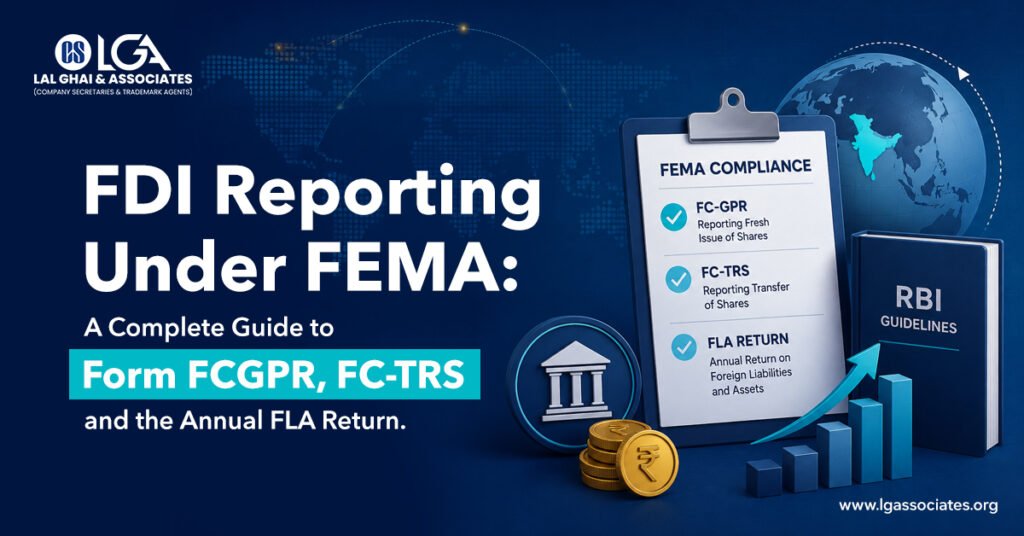
1. Form FC-GPR — Reporting Fresh Issue of Shares
Whenever an Indian company issues equity instruments (shares, compulsorily convertible debentures/preference shares, etc.) to a person resident outside India, and this qualifies as Foreign Direct Investment under the NDI Rules, 2019, the issue must be reported in Form FC-GPR through the Single Master Form (SMF) on the FIRMS portal, within 30 days from the date of allotment.
FC-GPR isn’t limited to a straightforward cash subscription. It also applies to:
- Bonus or rights shares issued to non-residents, including on amalgamation, merger or demerger
- Equity instruments issued pursuant to a cross-border merger
- Shares issued against funds otherwise payable by the company to the overseas party
- Sweat equity and shares allotted on exercise of ESOPs
- Shares issued on conversion of convertible notes
Interestingly, allotments under a public issue or a Qualified Institutional Placement do not need to be separately reported in FC-GPR — a useful exemption to keep in mind while planning a listing.
One point companies often miss: if shares are being issued to a person other than the one who actually remitted the money (say, a nominee or group-company arrangement), the filing must be accompanied by KYC reports of both the remitter and the beneficial owner, a no-objection certificate from the remitter, and a letter explaining the arrangement.
2. Form FC-TRS — Reporting Transfer of Shares
Form FC-TRS comes into play when equity instruments change hands between:
- A non-resident holding shares on a repatriable basis and a non-resident holding on a non-repatriable basis, or
- A non-resident holding shares on a repatriable basis and a person resident in India
The onus of filing rests on the resident transferor/transferee, or the non-resident holding shares on a non-repatriable basis, as applicable — not automatically on the company.
A transfer between a non-resident (non-repatriable basis) and a resident does not require FC-TRS reporting, which is a useful distinction for family arrangements and NRI shareholdings.
Transfers executed on a recognised stock exchange, and consideration paid on a deferred basis, also attract FC-TRS reporting obligations of their own.
3. The Annual FLA Return — An Obligation Even Without Any New Transaction
This is the filing that trips up the most companies, because it doesn’t depend on any transaction happening in the current year at all.
Any Indian company (or LLP) that has received FDI or foreign capital contribution in any previous year — even if no fresh investment came in during the current year and the earlier investment is still on the books — must file the Annual Return on Foreign Liabilities and Assets (FLA) with the RBI on or before 15th July every year, for the year ending the preceding 31st March.
The FLA return is filed through the dedicated web portal (flair.rbi.org.in), where entities first complete a one-time user registration to get their login credentials before submitting the return each year.
Many companies wrongly assume that once FC-GPR is filed, their FEMA compliance for that investment is complete. It isn’t — the FLA return is a recurring, annual obligation that continues for as long as the foreign investment sits on the company’s books.
Why This Matters: The Cost of Getting It Wrong
RBI applies a Late Submission Fee (LSF) for delayed filings — it is not a mere formality, and it is not waived easily. For transaction-based returns like FC-GPR and FC-TRS, the fee is calculated as a fixed amount plus a percentage of the ransaction value multiplied by the period of delay, subject to a cap of 100% of the transaction value. Filing late, or not filing at all, can also expose the company and its officers to compounding proceedings and penal action under FEMA.
The Practical Takeaway
FDI reporting under FEMA is a compliance calendar, not a one-time task. A company that
has taken foreign investment needs to track: the 30-day window after every fresh allotment
(FC-GPR), the transfer-triggered filing whenever shares move between residents and nonresidents (FC-TRS), and the non-negotiable 15th July deadline every single year (FLA) —
regardless of whether anything happened that year.
If your company needs help with FC-GPR, FC-TRS or FLA filings, or wants a compliance health-check on past FDI, Lal Ghai & Associates, Company Secretaries can assist — reach out through www.lgassociates.org.
Disclaimer: This article is for general awareness only and is not a substitute for professional advice on
your specific facts.