

How Founders Can Take Money Out of a Company: Salary, Dividends, ESOPs, Secondary Sales, Buybacks and Exits
A founder can receive value from a company through several legally recognised routes. The right documentation and tax treatment depend on the founder’s role, the company’s financial position and whether the transaction is with the company or another shareholder.
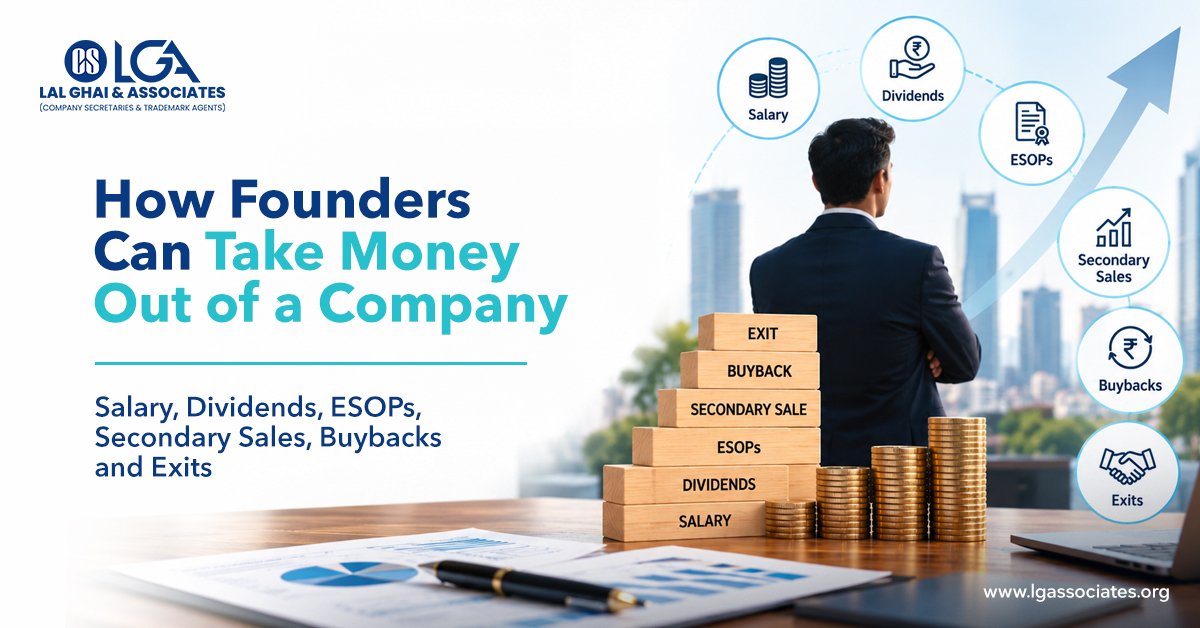
The routes at a glance
| Route | Who pays | How it is treated | Check first |
|---|---|---|---|
| Salary | Company | Pay, with withholding | Appointment papers, payroll records |
| Dividends | Company | Distribution, taxed in the shareholder’s hands | Distributable profits, approvals |
| ESOPs | Company issues shares | Perquisite at exercise, then capital gains on sale | SEBI rules, scheme type |
| Secondary sale | Another investor | Capital gains | Holding period, shares involved |
| Buyback | Company | Capital gains, plus extra promoter tax in specified cases | Law on the buyback date |
| Exits | Buyer or market | Depends on the route | Lock-ins, approvals |
| Other payments | Company | Rent, royalty, interest, reimbursements | Related-party, withholding, Section 185 |
1. Salary and managerial remuneration
Founder salary should be supported by employment/appointment documents, payroll records and applicable withholding. Public-company managerial remuneration is subject to additional Companies Act limits and approvals. Private companies should also document remuneration carefully, particularly where the founder is a director or related party.
2. Dividends
Dividends are distributions to shareholders governed by the Companies Act and the company’s available distributable profits and approvals. Dividend income is generally taxed in the shareholder’s hands under the prevailing income-tax regime, subject to applicable withholding and other provisions.
Dividend is therefore different from salary: it is a distribution, not a normal business expense.
3. ESOPs and sweat equity
Employee stock options are generally taxed as a perquisite when exercised and shares are allotted, followed by capital-gains taxation when the shares are sold. Eligible start-ups can obtain tax deferment for qualifying ESOP perquisites subject to the statutory conditions.
SEBI’s Share Based Employee Benefits and Sweat Equity Regulations, 2021 were last amended on 4 December 2025. Regulation 9A permits an employee identified as a promoter/promoter-group member in an IPO draft offer document to continue to hold/exercise certain benefits granted at least one year before the draft offer document, subject to the regulations and other applicable laws. This is not a blanket permission for fresh promoter ESOP grants.
Companies Act and Rules restrictions on sweat equity must also be checked. Listed companies must comply with the SEBI employee-benefit framework, and trust-based schemes require scheme-specific analysis.
4. Secondary sale of shares
A founder may sell shares directly to another investor or shareholder. For an individual resident shareholder, the tax result depends on the nature of the shares, holding period and taxpayer-specific provisions.
Unlisted equity shares held for more than 24 months generally fall within the long-term regime under the post-23 July 2024 rules, subject to the taxpayer and transaction details. A secondary sale is a shareholder-to-shareholder transaction and should not be confused with a company-funded buyback.
5. Buyback: major tax change from 1 April 2026
Buyback taxation has moved through different regimes. From 1 April 2026, the current law treats buyback consideration under the capital-gains framework and imposes an additional tax on promoters in specified circumstances.
The Finance Act 2026 framework produces an effective additional tax burden of 22% for a domestic-company promoter and 30% for other promoters when the statutory conditions apply. The actual computation depends on the promoter category and the nature of the gain.
A buyback should therefore be modelled using the law applicable on the actual buyback date; it should not be assumed to be automatically more or less tax-efficient than a secondary sale.
6. Exit routes
Strategic sale
Shareholders sell shares to a strategic buyer, subject to transaction documents and applicable approvals.
IPO
Shareholders may obtain liquidity through permitted market sales after listing, subject to lock-ins and securities-law requirements.
Buyback
The company purchases its own shares within the Companies Act/SEBI framework and applicable tax regime.
Secondary sale
An investor or founder sells shares directly to another investor.
7. Other founder payments
Rent, royalty, interest on genuine loans and reimbursement of properly incurred business expenses can be used where commercially justified and documented.
Related-party provisions, transfer pricing and withholding should be checked before implementation. Section 185 restrictions should be checked before director-related loans or advances. Potential deemed-dividend and related-party tax rules should be reviewed for closely held companies.
8. What founders should never do
Do not use the company bank account as a personal wallet, make undocumented withdrawals, or treat shareholder/director advances as informal drawings. Every movement of money should have a clear legal and accounting basis.
Key takeaway
Sources checked include the Income-tax Act, 2025 as amended for Finance Act 2026; Income Tax Department buyback/ESOP materials; Companies Act, 2013; and SEBI SBEB Regulations, last amended 4 December 2025.
Planning a payout, an ESOP scheme or an exit?
Our company secretaries can map the route, the approvals and the paperwork before any money moves.
Reach out through www.lgassociates.org | +91-94636 40466 | info@lgassociates.org