
Missed a FEMA Reporting Deadline? Here’s How RBI’s Late Submission Fee Actually Works

Missed a FEMA Reporting Deadline? Here’s How RBI’s Late Submission Fee Actually Works
Delayed a Form FC-GPR, FC-TRS, ODI return, or FLA filing? Before assuming the worst — or assuming it doesn’t matter — it helps to understand exactly how RBI’s Late Submission Fee (LSF) framework calculates what you owe, and what happens if you don’t pay it.
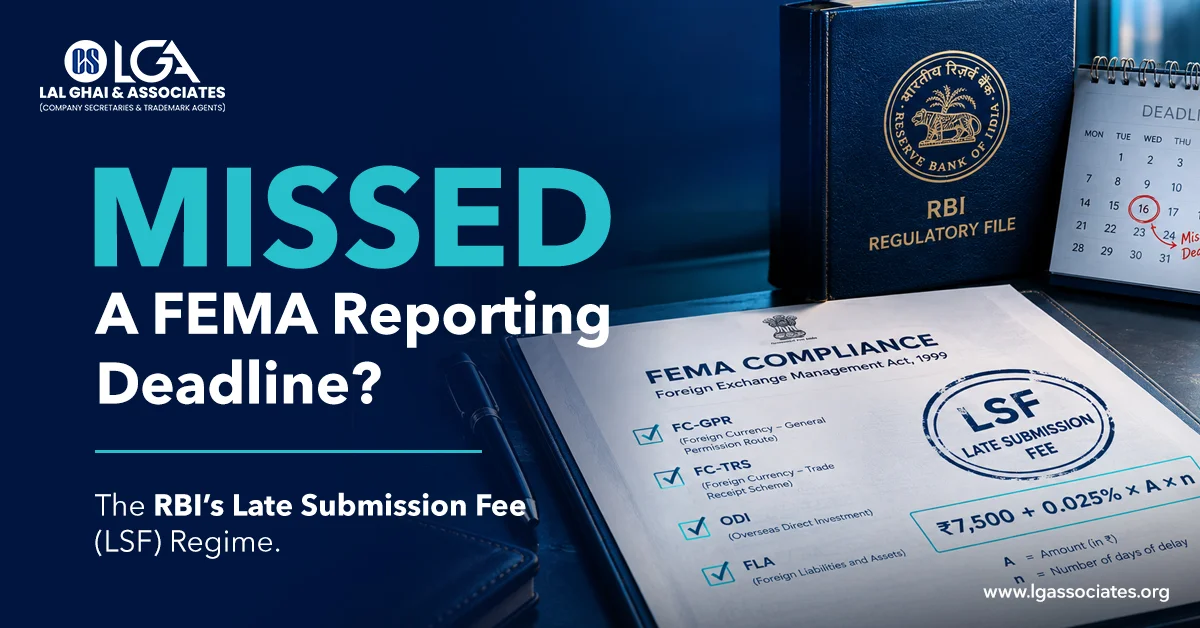
LSF Is a Structured Formula, Not a Flat Penalty
RBI applies a uniform LSF matrix across FEMA reporting delays, split into two categories:
So the longer the delay and the larger the transaction, the higher the fee — though it is capped at 100% of “A”, rounded up to the nearest hundred.
Category 1
Returns that don't capture flows
(e.g., Form ODI Part-II/APR, FCGPR-B, FLA returns, Form OPI, ECB/ECB-1 returns, evidence of investment, and other periodical reporting): a flat fee of ₹7,500, regardless of the size of the underlying investment.
Category 2
Returns that capture flows or transactions
(e.g., FC-GPR, FC-TRS, Form ESOP, Form LLP(I)/(II), Form CN, Form DI, Form InVi, ODI Part-I/Part-III, Form FC, Form ECB-2, and similar transactional filings): a formula-based fee of ₹7,500 + (0.025% × A × n), where:
A is the amount involved in the delayed reporting (for Form ECB-2, this is the gross inflow or outflow, whichever is higher)
n is the number of years of delay, rounded up to the nearest month and expressed to two decimal places
So the longer the delay and the larger the transaction, the higher the fee — though it is capped at 100% of “A”, rounded up to the nearest hundred.
A Few Details That Change the Calculation in Practice
Incomplete returns don’t stop the clock. If a return is submitted but is incomplete, the delay is treated as continuing until a complete return is actually received — a partial filing doesn’t freeze “n” at whatever it was on the submission date.
LSF payments are non-refundable. Once paid, there’s no mechanism to claim it back, even if it later turns out the fee was avoidable
There’s a three-year outer limit. The LSF route is available only up to three years from the due date of the original reporting or submission. Beyond that window, the option to simply pay LSF and regularise the delay is not available — the matter typically has to go through compounding instead, which is a more involved process.
If an LSF advice isn’t paid within 30 days, it becomes void. A fresh application at that point restarts the clock for calculating “n” from the date of the new application, rather than the original delay — so acting promptly on an LSF notice matters.
Filing late but not paying LSF is worse than either alone. If a person neither files within the specified time nor pays the applicable LSF, they remain exposed to penal action under FEMA — LSF is meant to be a regularisation route, not something that can be indefinitely deferred.
Why This Should Change How You Think About "Minor" Delays
It’s tempting to treat a delayed filing as a low-stakes administrative slip, especially for smaller transactions. But the compounding nature of the “n” variable means that what starts as a manageable fee can grow the longer it’s left unaddressed — and once the threeyear window closes, LSF is no longer an option at all. At that point, the only route to regularise the non-compliance is a formal compounding application to RBI, which involves more disclosure, more time, and generally a higher cost than paying LSF would have
The Practical Takeaway
If you’ve discovered a missed FEMA reporting deadline — whether it’s an old FC-GPR, an FLA return that was never filed, or an ECB return sitting incomplete — the right move is usually to compute the LSF exposure and regularise it promptly, rather than let the delay compound further or risk running past the three-year window into compounding territory.
If you’ve identified a delayed FEMA filing and want to understand your LSF exposure or regularisation options. Lal Ghai & Associates, Company Secretaries can assist — reach out through
www.lgassociates.org | +91-94636 40466 | info@lgassociates.org
Disclaimer: This article is for general awareness only and is not a substitute for professional advice on your specific facts.