

Planning a Dubai expansion?
Understand mainland, free-zone and offshore structures, UAE corporate tax, licensing and India’s overseas-investment rules before incorporating.
Dubai is a common base for Indian businesses seeking regional customers, international holding structures and access to the wider UAE and Middle East market. The correct structure depends on the activity, where the business will operate, tax profile, substance requirements and the Indian investor’s FEMA position.
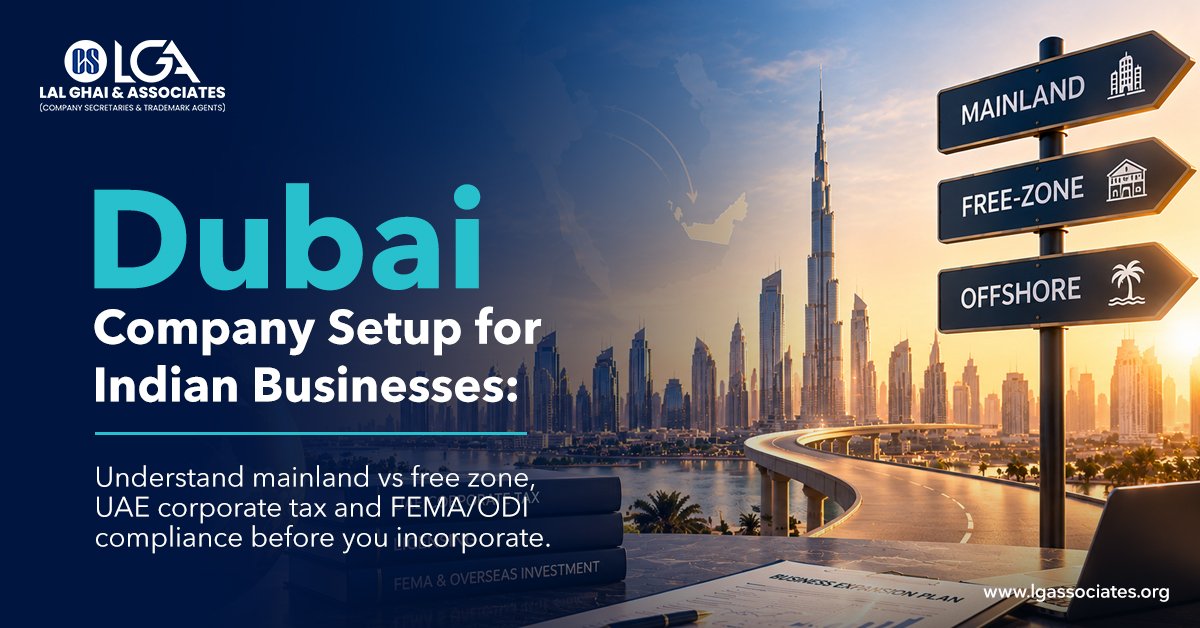
1. The three broad Dubai structures
| Structure | Commercial position | Typical use |
| Mainland | Licensed for mainland business in Dubai and, subject to the applicable licence and sector rules, wider UAE/international activity | Operating businesses serving the UAE market |
| Free zone | Operates under the selected free-zone authority; mainland activity requires the applicable DET licence/permit or other permitted route | International services, trading, technology and specialised activities |
| Offshore | Restricted/offshore structure; not a substitute for a UAE mainland operating licence | Holding and structuring purposes where the specific regime permits |
Foreign ownership can be available at 100% in many activities, but ownership, licensing and strategic-impact restrictions must be checked for the exact activity and jurisdiction. An offshore entity should not be treated as a general UAE operating company.
2. UAE Corporate Tax
UAE Corporate Tax generally applies at 0% on taxable income up to AED 375,000 and 9% on taxable income above that threshold. A Qualifying Free Zone Person can obtain 0% on qualifying income while other taxable income is generally subject to 9%, subject to the statutory conditions.
Small Business Relief is separate. An eligible UAE Resident Person can elect for the relief where revenue is AED 3 million or less in the current and all previous tax periods, subject to the conditions. A Qualifying Free Zone Person and a member of a qualifying large multinational group cannot elect for it. The relief is available for tax periods ending on or before 31 December 2026.
Free-zone status therefore does not automatically mean zero tax. Qualifying income, qualifying activities, substance, accounting/audit and transfer-pricing requirements should be reviewed.
3. Can a free-zone company operate in mainland Dubai?
Yes, but the licensing route matters. Dubai Executive Council Resolution No. 11 of 2025 provides mechanisms for eligible free-zone establishments to operate outside the free zone within Dubai, including a branch licence, a branch licence operating out of the free zone, or a temporary permit of up to six months, subject to the prescribed approvals and conditions.
A free-zone company should therefore obtain the required DET/free-zone permissions before commencing mainland activity rather than assuming that the free-zone licence itself covers mainland business.
4. Typical incorporation process
- Choose the precise activity and confirm whether it is regulated.
- Select mainland, free zone or offshore based on the business model.
- Reserve the trade name and obtain the required initial approvals.
- Prepare constitutional/incorporation documents and complete KYC.
- Arrange the office or other premises solution required for the licence.
- Obtain the commercial licence and establishment/immigration registrations where applicable.
- Open the corporate bank account and complete UAE tax registrations that apply.
- Put accounting, substance, payroll and transfer-pricing processes in place from the beginning.
5. India-side FEMA/ODI considerations
An Indian resident or Indian entity investing in a Dubai company must analyse the Foreign Exchange Management (Overseas Investment) Rules, Regulations and Directions, 2022. The framework distinguishes ODI, OPI and other financial commitments and contains route, eligibility, valuation and reporting conditions.
For an Indian entity, financial commitment under the automatic route is subject to the applicable limits, including the 400% of net-worth framework, with the precise computation and exclusions checked for the proposed transaction. The transaction must also be routed and reported through the authorised dealer bank as required.
- Resident individuals may use the Liberalised Remittance Scheme, subject to the USD 250,000 annual limit and applicable ODI/LRS conditions.
- An Annual Performance Report is generally required for ODI and is ordinarily due by 31 December, subject to the exceptions in the OI framework.
- Additional reporting can apply to further financial commitment, restructuring and disinvestment.
- Indian tax, transfer pricing, POEM and foreign-asset disclosure should be reviewed separately where relevant.
6. India–UAE structuring considerations
Before incorporation, map who will own the Dubai company, where management decisions will be made, which entity will contract with customers, where employees/functions will sit and how intellectual property and inter-company services will be documented. Incorporating a UAE entity does not by itself determine Indian tax residence or eliminate Indian tax/FEMA obligations.
Key takeaway
Sources checked include UAE Federal Tax Authority Corporate Tax materials; Dubai Executive Council Resolution No. 11 of 2025; and RBI Overseas Investment Regulations, 2022 and related directions. Licensing and tax treatment should be confirmed for the exact activity and transaction date.
Planning a Dubai Company?
Get the Structure and FEMA Route Right First
The right Dubai structure depends on your activity, where you will operate, your tax position and your FEMA/ODI obligations. Lal Ghai & Associates helps Indian businesses assess mainland, free zone and offshore options, plan the overseas-investment route and stay compliant from day one. — reach out through
www.lgassociates.org | +91-94636 40466 | info@lgassociates.org