

How Does Capital Structure Work, and Why Is It Important?
Capital structure is the way a company funds itself through equity, preference capital, debt and hybrid instruments. It affects ownership, dilution, repayment obligations, voting rights, investor economics and future fundraising flexibility.
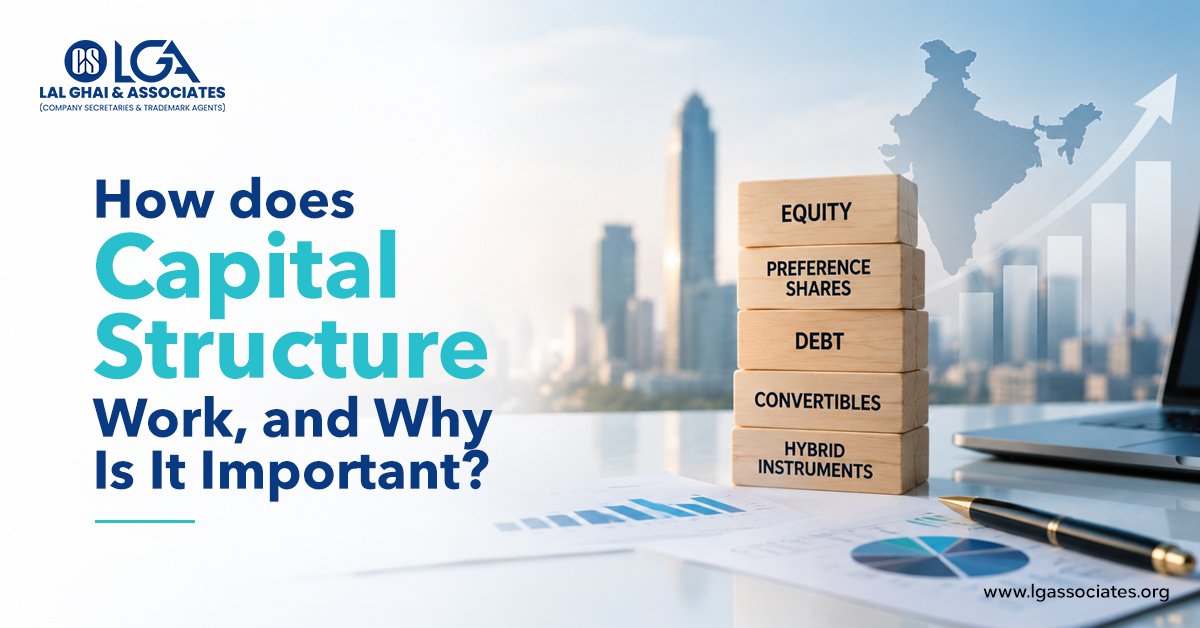
1. Main components
|
Instrument |
Economic character |
Typical use |
|
Equity shares |
Ownership and residual economics |
Founders, employees, investors |
|
Differential-rights equity |
Equity with specified voting/dividend variation where permitted |
Eligible founder/investor structures |
|
Preference shares |
Preferential dividend/capital rights |
Structured investment |
|
Debentures / loans |
Debt with repayment and interest |
Working capital and expansion |
|
Convertible instruments |
Hybrid until conversion |
Venture and structured funding |
|
SAFE/iSAFE-style contracts |
Contractual instrument; treatment depends on terms and applicable law |
Early-stage funding |
A SAFE/iSAFE-style document is a contractual instrument and is not, merely by name, a statutory Indian security.
2. Equity versus Debt
Equity generally does not create a fixed repayment obligation but dilutes existing holders. Debt usually preserves ownership but creates repayment and interest obligations. Interest may be deductible where statutory conditions are satisfied, but tax and transfer-pricing limitations can apply.
3. The Fully Diluted Cap Table
Founders should maintain a fully diluted cap table rather than looking only at current issued shares.
- Founder ownership
- Investor ownership
- Employee option pool
- Convertible instruments
- Warrants/options and other potential equity
- Voting and economic rights
The same denominator should be used across term sheets, investment documents and cap-table models.
4. Shareholder approvals
Different capital actions require different resolutions. A special resolution generally requires at least 75% of the votes cast by members entitled to vote who vote on the resolution.
An increase in authorised share capital is not automatically a special-resolution matter. Subject to the Articles and statutory requirements, it is generally approved by ordinary resolution, followed by the required ROC filing under Section 64.
Private placement, preferential issue, rights issue, buyback and specified securities each have their own approval and filing requirements.
5. Valuation and issue price
An issue at a premium is governed by the securities-premium framework, but a valuation report is not a universal requirement merely because shares are issued at a premium. Valuation requirements depend on the transaction and may arise under the Companies Act, tax law, FEMA or SEBI rules.
6. Foreign investment
Non-resident investment brings FEMA/FDI requirements in addition to the Companies Act. Sectoral caps, entry route, pricing, beneficial ownership and reporting should be checked before funds are received. Fresh issues commonly require FC-GPR reporting; specified transfers can require FC-TRS.
7. Dematerialisation of private-company securities
Rule 9B of the Companies (Prospectus and Allotment of Securities) Rules, 2014 requires eligible private companies to comply with dematerialisation requirements, subject to the applicable exemptions and deadlines. Small companies and government companies have specific treatment.
With effect from 1 December 2025, the paid-up-capital and turnover thresholds in the “small company” definition were expanded to ₹10 crore and ₹100 crore respectively, subject to the statutory exclusions. A private company should therefore check its status for the relevant financial year before concluding whether Rule 9B applies.
8. Common mistakes
- Issuing shares before confirming authorised capital.
- Using a valuation report prepared for the wrong statutory purpose.
- Negotiating dilution without a fully diluted cap table.
- Accepting foreign investment before checking sectoral cap, route and beneficial ownership.
- Treating a SAFE/iSAFE-style contract as automatically equivalent to an Indian statutory security.
- Missing ROC, FEMA or dematerialisation filings.
- Recording founder/director loans without checking Companies Act, tax and related-party restrictions.
9. Practical checklist
- Define the commercial objective.
- Choose the instrument and confirm its legal classification.
- Prepare a fully diluted cap table.
- Check authorised capital and Articles.
- Map Companies Act approvals and filings.
- Check FEMA/FDI if a non-resident is involved.
- Obtain transaction-specific valuation and tax advice.
- Complete allotment, ROC, FEMA, dematerialisation and register updates after closing.
Planning a Fundraise or Capital Restructuring?
The right capital structure should support your business’s growth plans while accounting for ownership, governance and regulatory requirements. Lal Ghai & Associates can help businesses assess their corporate structuring and compliance requirements.
Reach out through www.lgassociates.org | +91-94636 40466 | info@lgassociates.org