

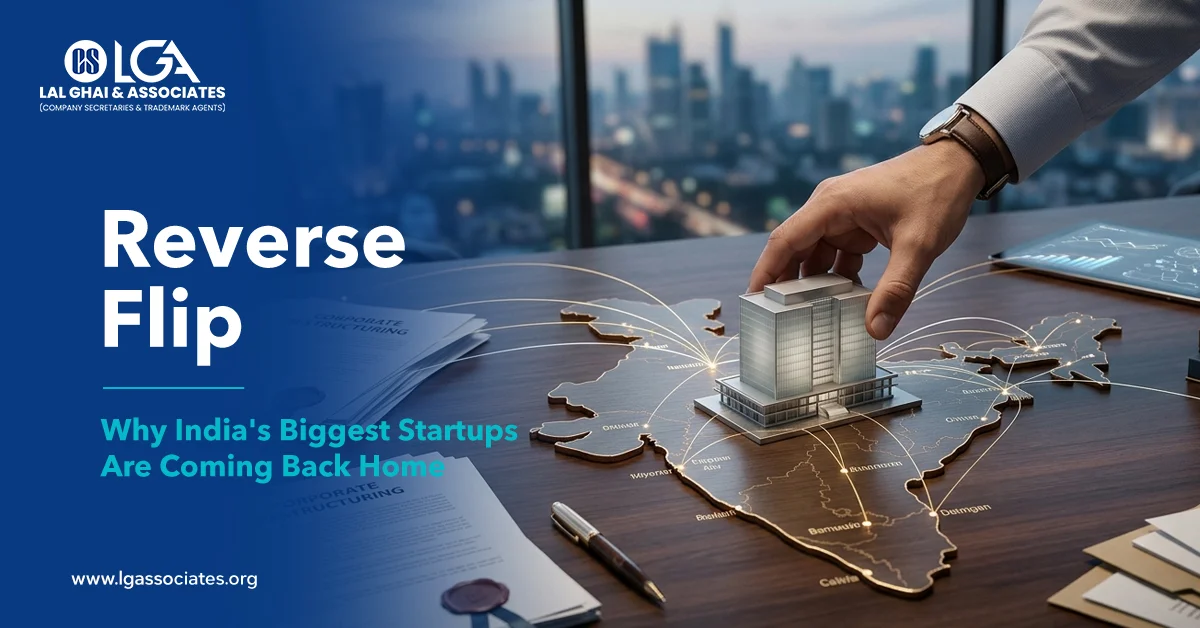
Reverse Flip: Why India’s Biggest Startups Are Coming Back Home
For years, the success story of an Indian startup often began with an overseas address.
From Singapore to Delaware, founders preferred incorporating their holding companies abroad to attract global investors, enjoy tax efficiencies, and access international capital. It became almost a standard playbook for startups with unicorn ambitions.
But today, the trend is reversing.
Some of India’s most celebrated startups are bringing their parent companies back to India through a process known as a reverse flip. What was once considered the ideal corporate structure is now being reconsidered as India emerges as one of the world’s most attractive destinations for business, investment, and public listings.
What is a Reverse Flip?
A reverse flip is a corporate restructuring process where an overseas holding company shifts its domicile back to India, making the Indian entity the ultimate parent company. In simple terms, the ownership structure that was once “flipped” abroad is now being “flipped back” to India.
This isn’t merely a change of address—it’s a strategic business decision involving legal, tax, regulatory, and corporate restructuring.
Why Are Startups Choosing India Again?
The answer lies in India’s rapidly evolving business ecosystem.
Indian stock markets have become increasingly attractive, offering higher valuations and strong investor confidence. Regulatory reforms have simplified the process of cross-border restructuring, while India’s startup ecosystem has matured significantly over the last decade. Since most of these companies generate the majority of their business, customers, and workforce in India, aligning the holding company with the operating business also makes commercial sense.
A reverse flip can also simplify corporate governance, improve regulatory alignment, and position companies better for an Indian Initial Public Offering (IPO).
Startups Leading the Trend
Several high-profile startups have already embraced this shift.
PhonePe completed its reverse flip from Singapore to India in 2022, becoming one of the first major unicorns to undertake the restructuring. Groww also shifted its parent company from the United States to India ahead of its proposed IPO. So does Zepto & Pine Labs.
These companies reflect a broader change in mindset—India is no longer just the market where business happens; it is increasingly becoming the place where businesses want to be headquartered.
Challenges Along the Way
Despite its benefits, a reverse flip is far from straightforward. Companies must navigate complex tax implications, foreign exchange regulations, shareholder approvals, court or regulatory clearances, and compliance requirements across multiple jurisdictions. Every transaction requires careful planning to avoid unexpected tax costs and legal hurdles.
The rise of reverse flips signals a new chapter in India’s startup journey. As capital markets deepen, regulations become more business-friendly, and domestic investors show increasing confidence, India is transforming from a launchpad for global ambitions into the preferred corporate home for its own startups.
For founders planning the next phase of growth, the question is no longer “Should we incorporate overseas?” Instead, it is increasingly becoming “Is it time to come back home?”
Planning a reverse flip or restructuring your startup for Indian growth and IPO readiness?
At Lal Ghai & Associates, we help founders navigate corporate restructuring, regulatory compliance, FEMA considerations, governance alignment, and capital market preparedness with a practical, business-focused approach. Connect with our team to evaluate the right structure for your next phase of growth.
www.lgassociates.org | +91-94636 40466 | info@lgassociates.org