
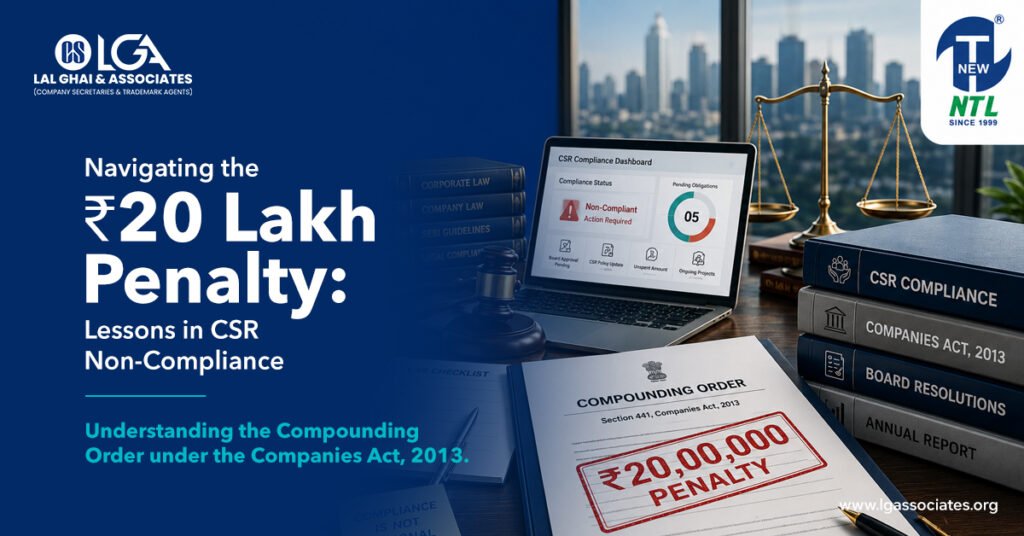
Navigating the Rs. 20 Lakh Penalty:
What the NTL India Limited CSR Compounding Order Teaches Every Eligible Company
A recent order from the Regional Director (Southern Region), Chennai, in the matter of M/s. NTL India Limited is a useful, real-world reminder of something many boards underestimate: Corporate Social Responsibility (CSR) compliance under Section 135 of the Companies Act, 2013 is not optional paperwork — it is a statutory obligation with real financial and personal consequences for directors.
Here’s what happened, what it cost, and what every CSR-applicable company — whether headquartered in Chennai, Ludhiana, or anywhere else in India — should take away from it.
The Case in Brief
NTL India Limited, along with its Managing Director, Whole-Time Director, and a former director, approached the Regional Director under Section 441 of the Companies Act, 2013, seeking to compound offences relating to CSR non-compliance for financial years 2015-16 to 2019-20. The violations cited were:
| Provision | Nature of Default |
| Section 134(3)(o) | Failure to include required Board’s Report disclosures on CSR policy and initiatives |
| Section 135(1) | Failure to properly constitute a CSR Committee |
| Section 135(3) | Committee’s failure to formulate, recommend, and monitor the CSR policy |
| Section 135(5) | Failure to ensure the mandatory CSR spend of at least 2% of average net profits |
The company had already filed Form GNL-1 (application for compounding) in November 2025, and the Registrar of Companies, Chennai, confirmed this was a first-time offence with no prosecution pending, raising no objection to compounding.
Why the Company Was Even Covered Under Section 135
Section 135(1) applies to companies crossing any one of three thresholds in the immediately preceding financial year:
- Net worth of ₹500 crore or more, or
- Turnover of ₹1,000 crore or more, or
- Net profit of ₹5 crore or more
Once a company crosses any of these thresholds, CSR obligations are triggered automatically — there is no opt-out. That includes constituting a CSR Committee of at least three directors, formulating a CSR policy aligned with Schedule VII activities, and spending a minimum of 2% of average net profits of the preceding three years on CSR initiatives.
The Defence Raised — and What the RD Actually Accepted
The applicants argued that:
- The default was unintentional, arising from procedural oversights rather than willful non-compliance
- It was a first-time offence, filed suo motu (voluntarily, before any regulatory notice)
- The lapse for FY 2020-21 onward coincided with the COVID-19 disruption and unavailability of professional consultants during that period
The Regional Director considered the ROC’s report confirming no prior prosecution, and the voluntary nature of the disclosure, and allowed the offences to be compounded — but not without a significant price tag.
The Cost of Non-Compliance: ₹20,00,000
This is the part that should get every board’s attention. The compounding fee was fixed individually for each applicant, not just the company:
| Applicant | Compounding Fee |
| M/s. NTL India Limited | ₹5,00,000 |
| Managing Director | ₹5,00,000 |
| Whole-Time Director | ₹5,00,000 |
| Ex-Director | ₹5,00,000 |
| Total | ₹20,00,000 |
Every officer in default paid personally — including a director who had already exited the company by the time the application was filed. Under Section 134(8), the underlying penalty exposure for this class of default runs from a minimum of ₹50,000 up to ₹25 lakh for the company, and imprisonment up to three years or a fine between ₹50,000 and ₹5 lakh (or both) for defaulting officers. Compounding converts that criminal exposure into a monetary settlement — but as this order shows, that settlement is far from token.
Post-Compounding Obligations Don't End There
The order didn’t stop at fee payment. The company was directed to:
- Intimate the jurisdictional Registrar of Companies within 7 days of the offence being compounded, under Section 441(3)(b)
- File the compounding order itself with the ROC in e-Form INC-28, within 30 days of receiving the order, under Section 441(4) read with Section 403
Missing either of these secondary deadlines can create a fresh compliance problem on top of the one just resolved — a detail that is easy to overlook once the fee has been paid and the matter feels “closed.”
What This Case Should Prompt You to Check
If your company crosses any of the Section 135(1) thresholds — or is approaching them — this order is a good trigger to review:
- Is your CSR Committee properly constituted, with at least three directors, and is it actually meeting and documenting its recommendations?
- Is your Board’s Report carrying the mandatory CSR disclosures under Section 134(3)(o) every year, not just in the years CSR spend was material?
- Is the 2% spend being tracked and met, or carried forward and disclosed correctly where unspent?
- If a lapse has already occurred, is it better to wait — or to file a voluntary compounding application now, before a regulatory notice forces the issue?
The NTL India case shows that voluntary, suo motu disclosure and a clean prior compliance record do work in a company’s favour before the Regional Director. But they don’t eliminate the fee — they only keep the outcome civil and predictable rather than adversarial.
How Lal Ghai & Associates Can Help
Our team regularly advises boards on Section 135 CSR compliance, Companies Act filings, and — where a lapse has already occurred — on compounding applications under Section 441 before the Regional Director or NCLT. If your company is CSR-applicable and you are even slightly unsure whether your Committee constitution, disclosures, or spend tracking are fully in order, a proactive review now is significantly less expensive than a compounding order later.
Get your CSR compliance reviewed — call our Ludhiana office at +91-94636 40466 or write to info@lgassociates.org.
Disclaimer: This article is a general commentary based on a publicly issued order of the Regional Director (Southern Region), Chennai, dated 27th April 2026, in CA No. 412/Sec.441/RD(SR)/2025-26. It is intended for informational purposes only and does not constitute legal advice. Companies should seek specific professional advice before taking compliance decisions.