
Sending money abroad for your child’s education, a family gift, medical treatment, or to buy an apartment overseas? Chances are your bank processed it under the Liberalised Remittance Scheme (LRS) — and behind that simple bank transaction sits a detailed RBI reporting framework that Authorised Dealer banks are required to follow.
What Is LRS,In Brief
Under LRS, resident individuals are permitted to remit up to USD 250,000 per financial year for any permitted current or capital account transaction, or a combination of both, as allowed under the Foreign Exchange Management (Current Account Transactions) Rules, 2000 and FEMA more broadly. This could cover overseas education, travel, medical treatment, gifts, donations, maintenance of close relatives abroad, investment in foreign equity or debt, or purchase of immovable property overseas.
How Banks Report LRS Transactions
This is where it gets interesting for anyone advising on cross-border remittances: the reporting obligation sits primarily with the Authorised Dealer, not the remitter directly, though the accuracy of what gets reported depends heavily on the purpose declared by the customer.
Daily (T+1) reporting:
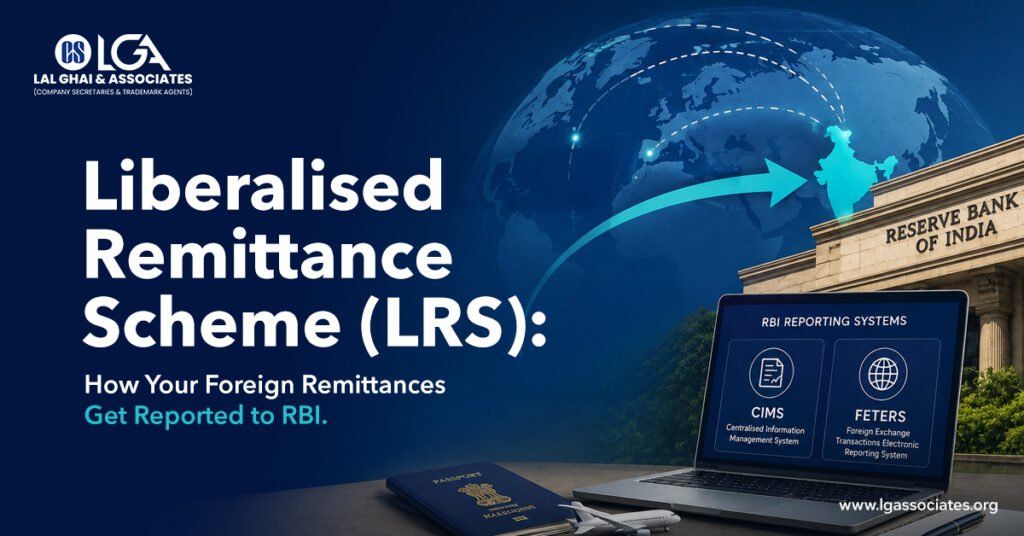
AD Category-I banks must furnish transaction-wise information on LRS remittances on a daily basis — by the close of business of the next working day — on RBI’s Centralised Information Management System (CIMS). This access has now also been extended to AD Category-II entities and Full-Fledged Money Changers (FFMCs).
Nil reporting:
If there’s nothing to report on a given day, a ‘Nil’ report must still be uploaded — silence is not an acceptable substitute for a nil filing.
Purpose codes:
Every LRS remittance is tagged against a specific purpose code — separate codes exist for opening a foreign currency account abroad, purchase of immovable property, investment in equity/debt/ESOPs, gifts, donations, travel (business, medical, education, employment, personal), maintenance of close relatives, medical treatment, studies abroad, and emigration.
FETERS reporting:
In addition to CIMS, these transactions also flow into the Foreign Exchange Transactions Electronic Reporting System (FETERS) maintained by RBI’s Department of Statistics and Information Management, classified by the actual nature of the transaction (travel, education, medical treatment, etc.) rather than a generic catch-all code. Banks are expected to ensure that what is reported in FETERS matches what is reported in CIMS.
Why This Should Matter to You, Not Just Your Bank
Even though the mechanical reporting is done by the AD bank, the purpose and accuracy of the declaration is the remitter’s responsibility. Misclassifying the purpose of a remittance, structuring transactions to stay under LRS limits across family members without proper basis, or using LRS proceeds for restricted purposes (like margin trading or purchase of lottery tickets, which fall outside permitted end-use) can invite scrutiny well after the money has already moved.
For businesses and professionals structuring outbound investments — whether it’s a resident individual investing in a foreign startup, buying overseas property, or funding a child’s education abroad — getting the purpose code and supporting documentation right at the time of remittance avoids complications later, particularly if the transaction is ever reviewed as part of a compounding application or a routine RBI audit of the AD bank’s LRS book.
The Practical Takeaway
LRS gives resident individuals meaningful flexibility to move money abroad, but every rupee remitted under the scheme leaves a reporting trail — daily, transaction-wise, and purpose-coded.
Need guidance on structuring an outbound remittance or LRS compliance?
If you’re planning a large remittance, or a series of remittances that might attract attention, it’s worth getting the classification and documentation right upfront rather than explaining it after the fact. — reach out through www.lgassociates.org.
Disclaimer: This article is for general awareness only and is not a substitute for professional advice on your specific facts